
CANARY ISLAND DATE PALM

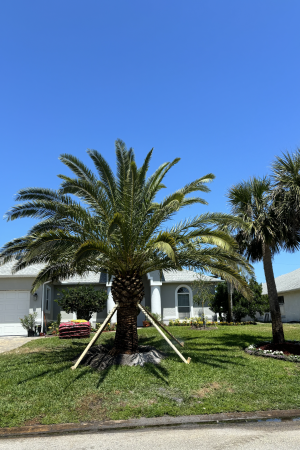
The Canary Island Date Palm (Phoenix canariensis), also called Pineapple Palm, is one of the most majestic and formal palms used in Florida landscapes. Here’s a detailed overview:
✅ Appearance & Characteristics
Fronds: Large, stiff, feather-like leaves (8–15 ft long) forming a dense crown.
Trunk: Thick, gray-brown with a distinctive diamond-shaped pattern from old leaf bases; often pruned into a “pineapple” shape near the crown.
Fruit: Produces small, orange-brown date-like fruits (edible but not tasty).
Spines: Sharp spines (2–3 inches) on the lower petioles—handle with care.
✅ Size & Growth
Height: Typically 40–60 ft, sometimes up to 70 ft in Florida.
Spread: Crown can reach 20–30 ft wide.
Growth Rate: Slow—about 6–12 inches per year; takes decades to mature.
USDA Zones: 9A–11 (ideal for most of Florida).
Cold Tolerance: Hardy to 15–20°F; leaves burn around 20°F, but the bud can survive near 10°F.
✅ Care & Maintenance
Light: Full sun is essential.
Soil: Well-drained sandy or loamy soil; avoid waterlogged areas.
Water: Drought-tolerant once established; water regularly during establishment.
Fertilizer: Use palm-specific fertilizer with magnesium and potassium 2–3 times a year to prevent deficiencies.
Pruning: Not self-cleaning—remove dead fronds only when fully brown; avoid “hurricane cuts.”
Spacing: Plant 25–30 ft apart; needs lots of room.
✅ Salt & Drought Tolerance
Salt: Moderately salt-tolerant—good for coastal areas but not direct beachfront.
Drought: Excellent drought resistance once established.
✅ Landscape Uses
Specimen Tree: Ideal for large lawns, estates, and Mediterranean-style homes.
Street or Boulevard Planting: Creates a dramatic, formal look.
Driveway Accents: Often used in pairs to frame entrances.
Commercial Spaces: Perfect for resorts, golf courses, and upscale developments.
⚠️ Things to Watch
Size: Too large for small residential yards.
Spines: Dangerous near walkways—keep away from high-traffic areas.
Pests/Disease: Susceptible to palm weevils, Ganoderma root rot, and lethal bronzing disease; avoid stress and overwatering.
Maintenance Cost: Professional pruning often required for tall specimens.
NOTE FROM JOEL
We have planted and transplanted thousands of these palm trees throughout Florida. Most were extremely large. We may have transplanted the tallest one ever in Florida with 50 feet of trunk height. All of the large ones are purchased from homeowners and can be anywhere from 15 to 80 years old. The Canary only grows at a normal rate of 6″ a year, sometimes fast as 12″ a year. I’ve met several homeowners that were stabbed with the thorns and hospitalized. Short ones are a definite hazard to children and pets, although they will only get poked once. An interesting note is how they got to Florida from the Canary Islands. I’m not positive about this, but the rumor is they were brought here by pirates. I’m going with that story. The Canary does much better in arid climates and can easily be overwatered. We like to plant them high so the water will run off them easily. I’ve had several that died because of overwatering. These are the most expensive trees in Florida but there is no other tree like it. The Canary Island Date Palm stands alone as the King of Palms.
