
SILVER BUTTONWOOD

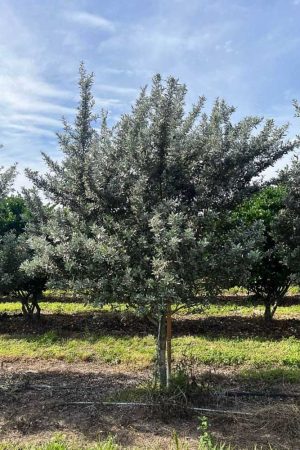
Silver Buttonwood (Conocarpus erectus var. sericeus) is a Florida native evergreen that’s highly valued for its striking silvery-gray foliage and adaptability to coastal conditions. Here’s a detailed overview:
Appearance & Characteristics
Leaves: Velvety, silvery-gray due to fine hairs; contrasts beautifully with green landscapes.
Form: Can be grown as a multi-trunk shrub or trained into a single-trunk small tree.
Flowers & Fruit: Small, greenish-white flowers in spring; followed by cone-like, red-brown fruits.
Bark: Dark brown, ridged, and scaly.
Wildlife: Attracts birds, butterflies, and pollinators. [edis.ifas.ufl.edu], [pslbg.org]
Size & Growth
Height: Typically 15–20 ft, but can reach up to 40 ft if left untrimmed.
Spread: About 15–20 ft.
Growth Rate: Moderate to fast.
USDA Zones: Best in Zone 10B–11
Care & Maintenance
Light: Full sun to partial shade.
Soil: Tolerates clay, sand, loam; prefers well-drained soil but adapts to nutrient-poor conditions.
Water: Drought-tolerant once established, but benefits from regular watering during dry spells.
Pruning: Minimal—just shape or remove damaged branches. Avoid cutting more than 1/3 at once.
Fertilizer: Apply 3 times a year (spring, summer, fall)
Salt & Drought Tolerance
Salt: Highly tolerant of salt spray and coastal winds—ideal for beachfront landscapes.
Drought: Excellent drought resistance once established. [sfyl.ifas.ufl.edu], [flnurserymart.com]
Uses
Landscaping: Hedge, privacy screen, specimen tree, patio accent, or coastal reclamation.
Urban Tolerance: Works well in parking lot islands, highway medians, and container planting.
Historical Use: Wood was used for charcoal and smoking meats. [thetreeplanters.com]
Things to Watch
Cold Sensitivity: Not suitable for areas with frost.
Pests/Disease: Can get aphids, scale, or black sooty mold inland.
Pets: May contain saponins, which can upset dogs’ stomachs. [gfloutdoors.com], [pslbg.org]
